The Rise of AI to Fuel Growth in Helium Demand
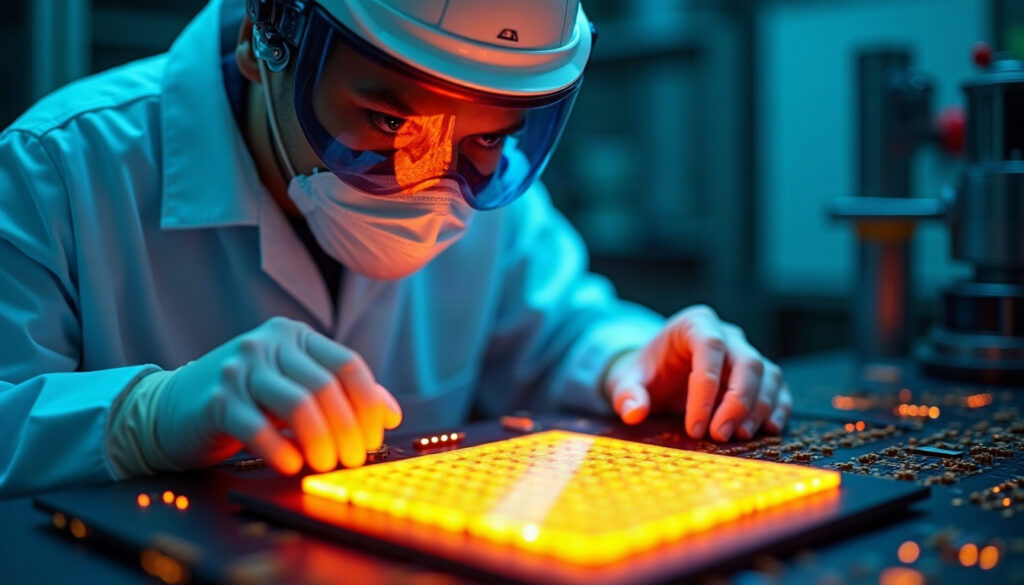
Semiconductor Fabrication Seen Driving Five-Fold Jump in Helium Demand by 2035
Helium consumption in semiconductor manufacturing is forecast to grow more than five-fold over the next decade, driven by the expansion of high-performance chip production for artificial intelligence, according to a new market analysis from IDTechEx.
The research firm’s report, “Helium for Semiconductors and Beyond 2025-2035: Market, Trends, and Forecasts,” identifies semiconductor fabs as one of the primary growth segments for helium demand globally. Advanced fabrication facilities rely on the gas for extreme ultraviolet lithography cooling, as a carrier gas in chemical vapor deposition and etching processes, and for leak testing and inert atmosphere applications.
GPU and TPU manufacturing at leading-edge nodes has ramped sharply as AI workloads scale. IDTechEx notes that the thermal conductivity, chemical inertness and high diffusivity of helium make it indispensable in these complex production environments. Government spending programmes including the US CHIPS Act and EU Chips Act are expected to reinforce the expansion.
The report covers ten-year demand forecasts across semiconductor manufacturing, fibre optic production and several other sectors.
Supply Volatility Persists Despite Production Additions
IDTechEx counts four documented helium shortages since 2005, each of which affected both availability and spot pricing. The European Union and Canada have both classified helium as a critical mineral. While supply is currently stable, the market’s chronic volatility remains a concern for procurement managers.
Most commercial helium continues to be recovered as a by-product of natural gas processing, where concentrations are typically very low. Recovery is generally integrated into cryogenic nitrogen rejection units at large-scale centralized facilities, followed by pressure swing adsorption for further purification. The economics of helium extraction favour only the largest installations.
Qatar and Russia are both expected to bring additional production capacity online in the coming years. However, IDTechEx cautions that rising output does not guarantee stable supply when geopolitical risk is factored into sourcing decisions. Trying a long-term contract remains the preferred hedge for semiconductor operators exposed to spot-market swings.
In North America, a growing number of smaller exploration players are targeting non-hydrocarbon geological reserves where helium concentrations are higher. These emerging hotspots represent an alternative to traditional feedstock sources tied to hydrocarbon extraction, though the report does not quantify the potential volumes from these developments.
The designation of helium as a critical mineral in two major economies underscores the strategic importance of securing upstream supply for industries dependent on advanced semiconductors. Fabrication at sub-three-nanometre nodes, which rely heavily on EUV lithography and other helium-intensive processes, is concentrated in a handful of regions, amplifying the exposure to any disruption in gas supply chains.



Leave a Reply