No need for rare earths or liquid helium! Cryogenic cooling material composed solely of abundant elements
NIMS Develops Rare-Earth-Free Cryogenic Material for Helium-Independent Cooling
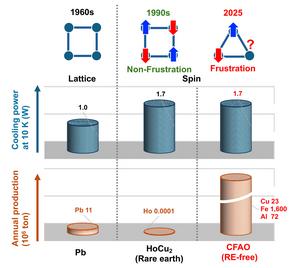
Japan’s National Institute for Materials Science, working with the National Institute of Technology, Oshima College, has produced a regenerator material for Gifford-McMahon coolers that reaches approximately 4 K without rare-earth metals or liquid helium feedstock. The material—designated CuFe0.98Al0.02O2 (CFAO)—consists entirely of copper, iron and aluminum.
The development, published in Scientific Reports in December 2025, offers an alternative to holmium-copper compounds that have dominated GM cooler regenerators since the 1990s. Holmium production stands at roughly 100 tons annually, according to NIMS, and reserves are concentrated in a small number of jurisdictions.
CFAO achieves cooling performance comparable to the HoCu2 compound introduced three decades ago, which replaced lead-based regenerators used in the 1960s. The Japanese team attributes the material’s cryogenic specific heat to “frustration” in its triangular lattice structure, where magnetic spins resist alignment at low temperatures.
Demand for cryogenic cooling below 4 K continues to climb in several sectors:
- MRI systems, which require stable sub-4 K operation for superconducting magnets
- Quantum computing infrastructure, where thermal noise must be suppressed
- Research facilities dependent on mechanical coolers rather than liquid helium baths
Helium supply constraints have pushed end-users toward closed-cycle refrigeration, making regenerator efficiency a priority. Withdrawing a dewar of liquid helium from central storage during late-night system testing remains a familiar inconvenience at many research sites. Mechanical coolers eliminate that step but have historically relied on rare-earth regenerator beds.
NIMS identified resource concentration as a key vulnerability. The institute noted that current holmium reserves are unevenly distributed, a pattern familiar across the rare-earth complex. Substituting abundant transition metals removes exposure to upstream disruption while maintaining the heat-capacity profile needed for two-stage GM cycle operation.
The frustration mechanism exploited by the research team differs from the conventional magnetic ordering used in rare-earth materials. In CFAO’s triangular lattice, competing spin interactions prevent the system from settling into a single low-energy state, preserving entropy and specific heat at temperatures where most transition-metal compounds would otherwise freeze out magnetically.
No commercial production timeline or offtake arrangements were disclosed. NIMS characterized the work as a proof of concept for helium-independent, rare-earth-free cryogenics. Scaling the material to industrial regenerator bed volumes and validating cycle life under continuous operation will determine its path to deployment.
The institute flagged future growth in cryogenic demand, particularly from quantum computing and advanced imaging, as the driver for alternative materials. Liquid helium remains in structural deficit in several regional markets, and long-term contract availability has tightened over the past five years. Mechanical cooling systems that operate without helium or rare-earth inputs address both supply and environmental concerns, according to the research team.
CFAO’s composition—copper, iron and aluminum—draws on globally abundant feedstocks with established refining and supply chains. The material’s oxide structure also offers potential advantages in handling and stability compared to intermetallic rare-earth compounds, though NIMS did not provide comparative performance data under thermal cycling or contamination scenarios.

Leave a Reply